Featured Post Today
Latest Post

Ethnic minorities schedule conference for September

The previous ethnic trust-building conference was held in March. (SNLD)  

By NANG MYA NADI (DVB)

Political representatives of Burma’s ethnic minorities including the Shan, Karen, Chin, Mon and Karenni have announced that they will hold a trust-building conference in September aimed at establishing a unified voice with which to engage in dialogue with the Burmese government.

The announcement comes after a meeting of ethnic politicians and representatives of various ethnic armed groups on 23 August in Taunggyi, capital of Shan state.

Speaking to DVB on Monday, Sai Leik, a spokesman for the Shan Nationalities League for Democracy, said the delegates had requested permission from the minister of Shan state to hold such a conference and that they were looking forward to forming a political agreement.

“We will discuss issues relating to democracy, federalism and amendments to the 2008 constitution,” he said, adding that topics such as self-determination and equality would also be tabled.

Smaller ethnic groups such as the Pa-O will be represented at the conference while civic groups including 88 Generation and political prisoners campaign groups will attend as observers.

Sai Leik said that the ministers for Shan, Karenni and Mon states and their respective house speakers will be invited to attend, as will representatives of the Myanmar Peace Center.

Governments Want Vietnam to Review New Internet Control Decree

A customer surfs the Web on his tablet at wi-fi cafe in downtown Hanoi, Aug. 1, 2013. AFP
By Parameswaran Ponnudurai (RFA)

A coalition of 21 governments spanning five regions called on Vietnam Monday to review a controversial Internet decree that will come into force on Sept. 1, warning that it risks harming the one-party Communist state's economy, limits innovation and deters foreign investment.

The Freedom Online Coalition said it "is deeply concerned" by the Decree 72, which will impose further restrictions on the way the Internet is accessed and used in Vietnam and that would curb freedom of speech and restrict information people can share on social media.

The coalition was established two years ago by governments wanting to collaborate on efforts to advance Internet freedom. It comprises governments from Asia, Africa, Europe, the Americas, and the Middle East, including the United States and several other key developed nations.

"Decree 72 risks harming Vietnam’s economy by constraining the development of businesses in Vietnam, limiting innovation, and deterring foreign investment," said the spokeswoman for the U.S. State Department, Marie Harf, in a statement.

"An open and free Internet is a necessity for a fully functioning modern economy; regulations such as Decree 72 that limit openness and freedom deprive innovators and businesses of the full set of tools required to compete in today’s global economy," she said.

The Freedom Online Coalition called on the Vietnamese government "to revise Decree 72 so that it promotes the ability of individuals to exercise their human rights, including the right to freedom of expression."

Aside from the United States, the coalition comprises Austria, Canada, Costa Rica, Czech Republic, Finland, France, Estonia, Georgia, Germany, Ghana, Ireland, Kenya, Latvia, the Republic of Maldives, Mexico, Mongolia, The Netherlands, Tunisia, the United Kingdom and Sweden.

Storm of protest

Decree 72 has ignited a storm of protest among Vietnam’s Internet users and international groups such a Google and Facebook as well as governments since it was made public last month.

It contains a clause stipulating that blogs and social media sites should only be used to share “personal information” and not news articles. 

The decree also requires foreign companies to have at least one server inside the country, a move that gives the Vietnamese government some control over their activities and increases costs for multinational companies seeking to expand in Asia.

The Asia Internet Coalition, formed by eBay, Facebook, Google and Yahoo!, said the decree would "negatively affect Vietnam's Internet ecosystem" and deter foreign investors.

The Freedom Online Coalition said Monday that that Decree 72 appears to be inconsistent with Vietnam’s obligations under the International Covenant on Civil and Political Rights, as well as its commitments under the Universal Declaration of Human Rights.

It noted that a resolution adopted by consensus by the UN Human Rights Council in July last year confirms that human rights apply online as well as offline.

Global media watchdog Reporters Without Borders said Decree 72 is the “harshest offensive against freedom of information” in Vietnam since 2011, when the government introduced Decree No. 2 setting out sanctions for journalists who violate a series of vague provisions.

China's Bo Trial Closes Amid Calls For 'Severe Punishment'

Bo Xilai is removed from the courtroom at the conclusion of his trial in Shandong province, Aug. 26, 2013. AFP PHOTO / CCTV
Authorities in the eastern Chinese city of Jinan wrapped up the sensational trial of fallen ruling Chinese Communist Party political star Bo Xilai on Monday with demands from prosecutors for a "severe" punishment for the former Chongqing Party chief at the heart of a murder and corruption scandal.

Bo's crimes of bribery, embezzlement and abuse of power were "extremely serious" and there were no mitigating factors, prosecutors told the Jinan Intermediate People's Court on Monday, using key terms used in Chinese law to determine whether a death penalty is appropriate.

"The prosecution demanded a heavy sentence in line with the law, as Bo committed very serious crimes," court spokesman Liu Yanjie told reporters at a news conference following the trial, which ended just after 1:00 p.m. local time.

"He pleaded not guilty to the charges, and there are no extenuating circumstances suggesting lighter punishment. It must be dealt with severely according to the law," the prosecution was quoted as saying in the official edited transcript of the trial posted to the Court's account on the Twitter-like service Sina Weibo.

Judges may hand down the death penalty in cases of bribery involving more than 100,000 yuan (U.S. $16,000), in the absence of a guilty plea or any mitigating circumstances.

The prosecution told the court: "The defendant's crimes are extremely serious."

The court will announce the verdict "at a date to be decided," the official news agency Xinhua reported after the trial ended.

'Soap opera'

In the final hours of the trial, which was initially scheduled for two days and extended to five, Bo likened the case against him to the plot of a "bad soap opera," telling a tale of starred-crossed relationships, mental health problems, and corrupt practices going on around him, of which he was unaware.

Bo exposed what he said was a tangle of love relationships between himself, extramarital lovers, his wife Gu Kailai, murdered British businessman Neil Heywood and his former Chongqing police chief Wang Lijun, who gave evidence on Sunday.

In what has been the most politically charged trial of a former high-ranking Party member since that of Mao's wife Jiang Qing in 1980, the outspoken and charismatic Bo mounted a feisty defense, cross-examining witnesses, dismissing his wife as "insane," and attacking the standard of the evidence presented against him throughout.

In his final words to the court, Bo painted himself as a largely honest official, yet an unfaithful husband, "haunted" by regret and unable to govern his own family or officials.

"I'm trapped deep in the disaster of being in prison," he said. "I'm haunted by all sorts of feelings and all I have left is the remaining time of my life."

"I failed to keep my family members and subordinates within bounds. I made significant mistakes. I feel guilty towards the party and the public."

But while Bo admitted he had made mistakes linked to the Heywood murder investigation and bore "some responsibility" for embezzled state funds that transferred to one of Gu's bank accounts, he denied all formal charges against him.

In Friday's session, he dismissed Gu as "insane," told Wang he was "full of lies and fraud," and compared another prosecution witness to a "mad dog."

Wang's Feb. 6, 2012 flight to the U.S. Consulate in Chengdu had been motivated by his love for Gu, which "confused and overwhelmed" him. Sources close to the case have previously suggested that Wang was hoping to save his own skin after it emerged that Gu was a chief suspect in the Heywood murder.

Retracted confession

"I hadn't expected him to retract his confession," said Jiang Weiping, a Canada-based political analyst and former journalist with the official Xinhua news agency.

"Even though he [wasn't addressing the facts] in the trial, [I thought] that was in line with his personality and his mindset, and that it wouldn't influence the final outcome," said Jiang, who served six years in prison on charges of revealing state secrets after he wrote articles exposing official corruption, including about Bo's tenure in Dalian.

"Based on the evidence presented in court ... he has still been active in hindering the investigation."

On Monday, Bo said he had signed a confession while in custody of Party investigators in the hope of resuscitating his political career.

Jiang said Bo's retraction of his confession could be a tactical move, made in the hope of his eventual rescue.

"If they don't bring Bo Guagua back to China immediately, then he will have in his possession unimaginable wealth, vast sums, which he could use to overturn the case against Bo Xilai, and claim it was a miscarriage of justice," Jiang said.

"There have already been signs of this, so I think the government will move ahead with this process after the Bo case is wrapped up."

Gu was handed a suspended death sentence, commutable to a lengthy jail term on good behavior, in August 2012, for her role in Heywood's murder.

Wang was jailed for 15 years last September for corruption, abuse of power and defection.

'Last performance'

Veteran China analyst Willy Wo-lap Lam said Bo's appearance at the trial would likely be his last in public.

"This was Bo Xilai's last performance before leaving the political stage," Lam said. "He wanted to oblige his supporters, the leftists, and the people of Chongqing, and that's why he put up such a fight."

"He also wanted to address the historical record."

Bo's populist campaigns of revolutionary songs and anti-crime campaigns won him many plaudits in Chongqing, but lawyers and defendants caught up in his "strike black" campaigns say they were rife with forced confessions, torture and other abuses, with many people targeted for their wealth.

While more than 100 people attended the trial, most media organizations were restricted to reading delayed transcripts of the proceedings on the Court's Weibo account, and no live television footage was available. No foreign media were allowed into the courtroom.

The transcripts were sometimes delayed, and one mentioned Bo's consulting his "superiors" in the aftermath of Wang's flight to Chengdu, before being withdrawn and republished with that section deleted.

Bao Tong, a former political aide to late ousted premier Zhao Ziyang, hit out at claims by state media that the publication of transcripts showed a high level of confidence from China's new leadership under President Xi Jinping.

"If this was a true live broadcast, I would indeed believe that it reflected a high level of confidence from the new leadership," Bao Tong said in an essay broadcast on RFA's Mandarin Service at the weekend.

"But a new problem has emerged. The genuine live broadcast has now been replaced by a counterfeit copy," Bao wrote.

"Who can say what that shows us?"

Beijing-based rights lawyer Mo Shaoping said there were still many questions left unanswered by the trials of all three main players in the scandal.

"It's crucial to have the correct legal process," Mo said. "Without it, [convictions] can be overturned later because people complain that they didn't receive due legal process in their trial."

"Of course, no one seriously doubts the case against Bo, but it's a politically driven trial, which means that strictly speaking it's not a legal trial."

Reported by Xin Lin, Yang Fan and Xin Yu for RFA's Mandarin Service, and by Hai Nan for the Cantonese Service. Translated and written in English by Luisetta Mudie.

Activists slam Association Law that would ‘criminalise’ dissent

Aung Soe, one of the leaders of demonstrators peacefully protesting against the Latpaduang Copper Mine, is arrested by police in Rangoon on 2 December 2012.
By HANNA HINDSTROM (DVB)

Burma must reject or amend a draft association law which would allow the government to ban or impose criminal penalties on civil society groups for exercising free speech, Human Rights Watch (HRW) said on Monday.

If passed in its current format, the law would require non-governmental organisations (NGOs) to register with a military-backed body that can arbitrarily reject applications, leaving activists vulnerable to arrest and prosecution.

HRW described the legislation as “contrary” to international law, including the right to freedom of association and speech, and accused the quasi-civilian regime of backtracking on its democratic reform programme.

“It seems the government wants to keep its stranglehold over civil society, effectively muzzling watchdog groups during this critical reform period,” said Phil Robertson, deputy Asia director at HRW.

Activists who fail to register with the government board face up to three years in jail, and its decisions are not open to appeal. The legislation is likely to prevent exiled groups, set up by pro-democracy activists who fled Burma during decades of military-rule, from returning home.

Wong Aung from the Shwe Gas Movement, which campaigns for the sustainable use of Burma’s natural resources, described the law as “unconstitutional” and “repressive”.

“Because this law can control and punish civil society groups by means of various charges, it seems likely to create even more prisoners and exiles if abused by the authorities,” he told DVB on Monday. “There is already a huge commitment to civil society activity inside Burma, and we fear that these activities could disappear at any time.”

He added that the Thailand-based Shwe Gas Movement would like to set up formal operations inside Burma where it has become increasingly active, but the government could easily block these efforts.

“Because our organisation focuses on human rights and corporate accountability, we are concerned that the law could inhibit our work,” said Wong Aung. “We are also concerned that if this law passes we will not be able to obtain registered status due to the nature of our work.”

It comes amid growing pressure on Thailand-based groups to relocate back to Burma, as international donors continue to slash funding for exiled NGOs and step up diplomatic relations with Naypyidaw.

Under the new law, international organisations would also be required to sign a memorandum of understanding with the government, which according to HRW “could severely hamper their legitimate activities”.

The UN’s special rapporteur for human rights, Tomás Ojea Quintana, has previously said the law would be “a serious setback for the development of a strong and vibrant civil society” in Burma.

The association draft is the latest example of legislation introduced since the nominal end of military rule in March 2011 that could be used to stifle democratic dissent. For example, a new printing and publishing law passed by the upper house of parliament on Monday includes some similar provisions to the regulation it is set to replace such as requiring media outlets to “register” with a government-backed board.

Meanwhile, dozens of peaceful activists have been prosecuted and jailed under a 2011 law, which criminalises the right to protest without permission.

“Burma is slowly emerging from decades of harsh authoritarian rule where many groups faced either control by the government or being forced into exile,” warned Robertson. “The draft Associations Law threatens the recent gains made by Burmese civil society groups and will undercut efforts to hold the government to account in the reform process.”

Rice exports down but annual forecast positive

Farmers plant rice seedlings in a paddy field on the outskirts of Rangoon in 2012. (Reuters)
By THIKE ZIN (DVB)

Burma exported some 200,000 tonnes of rice between April and July, but that’s 100,000 tonnes short of last year’s figures.

According to the chairman of the Myanmar Rice and Paddy Traders Association, the 50 percent decrease in shipments is due to an increase in the Burmese rice price, a decrease in Indian prices, and adverse weather conditions.

The price per tonne for low-quality Emata rice (25 percent broken) in Rangoon today stands at US$360- $370, compared with $330 on the international market.

In addition, Burma has been hit with adverse weather conditions recently, with floods in the Irrawaddy delta and a drought in Upper Burma.

However, exports at the Sino-Burmese border are up significantly according to a local trader from Muse.

“Last week only 600 tonnes of rice passed through the border, but this week it’s up to 1,000 tonnes,” he said.

The chairman of Myanmar Rice and Paddy Traders Association, Aung Than Oo, remained upbeat, saying that while Burma exported some 1.4 million tonnes of rice in 2012, this year he expects the total to hit 2 million tonnes.

Htan Gone unrest

In the early hours of Sunday morning a mob of about 1,000 local Buddhists carrying sticks and swords attacked Muslim villagers in Htan Gone village, Sagaing region.

MP blames local authorities for Htan Gone riot

A boy salvages among the burnt debris after a night of anti-Muslim rioting in Htan Gone village in Sagaing Division.
By AYE NAI (DVB)

Kanbula township MP Myint Naing has blamed local authorities for a lack of preparation in the wake of a riot which resulted in dozens of Muslim properties being burnt down in the village of Htan Gone where 50 percent of the population is Muslim and the other half Buddhists.

The upper house representative of Sagaing’s division’s constituency 3, a member of the opposition National League for Democracy (NLD), also criticised the township administration for a lack of transparency over the incident.

Myint Naing told DVB that he had travelled on Sunday to Htan Gone where he met with district police chief Col Ohn Hlaing. However, he said he was denied the opportunity to talk with 12 detainees who were arrested for rioting.

“The local police said they will investigate the case and release a statement in due course,” the NLD representative said. “But they didn’t allow me to meet with the suspects and they didn’t tell me where they were being detained.

“Where is the transparency?” he said. “This incident occurred due to a lack of preparation by the township administrators.”

Myint Naing added that he intends to visit Shwebo prison where a Muslim youth is being held on suspicion of attempting to rape a Buddhist woman in Htan Gone on Saturday evening. When rumours spread in the town that a Muslim had been detained over rape allegations, a mob of Buddhists quickly ascended upon the local police station where he was being held and demanded he be handed over. When police refused, the mob began looting and burning Muslim properties.

Myint Naing said he was told that many of the rioters were not from Htan Gone.

DVB tried to contact the police and administration office for independent verification but were unable to get a reply.

Myanmar get green light for SEA Games

A worker lays pavement stones in front of the new Wunna Theikdi Football Stadium in Naypyidaw, Myanmar, in March. OCM secretary Datuk Sieh Kok Chi said Myanmar is ready to host the SEA Games in December. – EPA Photo
By RAJES PAUL
The Star Online

KUALA LUMPUR: Finally, it is a thumbs-up for the SEA Games in Myanmar - just three months before its kickoff in December.

After months of uncertainty over its readiness, Olympic Council of Malaysia (OCM) secretary Datuk Sieh Kok Chi said that it was all systems go for Myanmar to host the 27th edition of the biennial games.

Kok Chi said that he was impressed with the way things had turned around after a recent visit to Myanmar this month. Myanmar is hosting the Games for the first time after 44 years. The country last hosted the Sea Games in 1969.

“Most of the venues are ready. All the venues have excellent facilities - except for hockey. It is not so impressive as hockey is not a very popular sport in Myanmar. The covered stands can seat about 800 spectators and they have promised to add temporary seats,” said Kok Chi.

“The other facilities are impressive. The Main Stadium is brand new and has world class facilities. The venue for equestrian covers a very large area and it has covered and open air pitches. In fact, a test event had been successfully conducted at this venue.

“I do not foresee any major logistic problems as we had feared initially.”

In fact, Myanmar Airlines are providing direct flights for athletes and officials from Kuala Lumpur to Naypyidaw directly during the Games; no visas are required for athletes and officials; there are sufficient hotels for supporters; and internal transportation will be provided for visitors from hotels to all competition venues for a minimal fee.

On the Games Village, Kok Chi said: “The Games Village is in Naypyidaw and it can house 6,400 occupants. All the apartments are air-conditioned. In Yangon, the athletes and officials will be housed in hotels.”

Myanmar are hosting a total of 33 sports and Malaysia are taking part in 30 of them. The bulk of the sports will be hosted in Naypyidaw while six will be held in Yangon. Only the women’s football and sailing will be held at two different cities - Mandalay and Pathein.

Kok Chi said that the host had also completed the technical books for every sport and has distributed the accreditation forms to every participating country. In fact, OCM completed their selection of athletes by names on Friday.

“Except for athletics, we have finalised the selection of athletes for other sports. Currently, we have finalised the participation of 529 athletes for 30 sports. We are not taking part in vovinam, kempo and the traditional boat race. The MAF (Malaysian Athletics Federation) will confirm the names after their national meet soon,” said Kok Chi. A total of 125 athletes will be going under Category B and for the first time, badminton’s women shuttlers have been classified in this category. The Badminton Association of Malaysia (BAM) had requested for 16 players but three women shuttlers were listed under Category B.

“The selection committee felt that the standard of the national women shuttlers had dropped. Some women shuttlers - the second-ranked sinlges and doubles shuttlers are young and raw.”

The BAM have to fund the athletes under Category B and they will be reimbursed if these players win medals at the Games.

A total of 460 events will be contested and, Kok Chi said, for now Malaysia will be happy to win at least 10% of it - ranging from 35-40 gold medals.

Riots in Kanbalu, Sagaing Division

Riots in Kanbalu, Sagaing Division

Twelve arrested after fresh unrest in Myanmar

Myanmar has been grappling with sectarian unrest since 2011. [Reuters]
Dozens of homes set ablaze in rioting in central village of Kanbalu following attempted rape of woman.

Aljazeera.com

At least 12 people have been arrested after a renewed bout of religious violence in Myanmar's northern Sagaing region in which dozens of homes were set ablaze.

The Ministry of Information said the sectarian unrest in a central village of Kanbalu followed the attempted rape of a Buddhist woman by a Muslim man on Saturday evening.

According to the statement, after the man was detained, about 150 villagers and three Buddhist monks gathered at the police station, demanding he be handed over to them.

When the police refused, the mob rioted, destroying Muslim bulildings, throwing rocks at police and attacking firemen

About 1,000 Buddhists, some carrying sticks and swords, attacked Muslim villagers the same night, destroying more than 40 homes and shops, witnesses said.

Calm was restored on Sunday. Witnesses said some Muslims fled to neighbouring villages or sheltered in a Muslim school.

A Muslim eyewitness said the cause of the unrest appeared to have been an argument between a young Muslim man and a Buddhist woman, but he denied the man attempted to rape the woman.

Myanmar has been grappling with sectarian violence since the country's military rulers handed over power to a nominally civilian government in 2011.

The unrest began last year in the western state of Rakhine, where Buddhists accuse the Rohingya Muslim community of illegally entering the country and encroaching on their land.

Last week watchdog Physicians for Human Rights said Myanmar risked "catastrophic" levels of conflict with "potential crimes against humanity and/or genocide" if authorities failed to stem anti-Muslim hate speech and a culture of impunity around the clashes.

Rights groups have accused authorities of being unable or unwilling to contain the unrest, which has left about 250 people dead and more than 140,000 homeless. The vast majority of victims have been Muslim, who make up at least four percent of the population. Myanmar has rejected the claims.

Burmese Navy Expels Farmers on Confiscated Land in Dala, Rangoon


At Least 15 Uyghurs Killed in Police Shootout in Xinjiang

A map of Xinjiang showing Kashgar's Kargilik (Yecheng) county. RFA
Chinese authorities have shot dead at least 15 ethnic Uyghurs in a desert area in Xinjiang, accusing them of terrorism and illegal religious activity, in the latest violence to rock the troubled northwestern region of China, according to police sources.

They were among a group of more than 20 Uyghurs surrounded and fired upon by police in a lightning raid last week in the Yilkiqi township in Kargilik (in Chinese, Yecheng) county in Kashgar prefecture, the sources said.

"We conducted an anti-terror operation on August 20th, successfully and completely destroying the terrorists," Yilkiqi township police chief Batur Osman told RFA's Uyghur Service.

He refused to give the number of Uyghurs killed in the shootout, saying many of them were from out of town and some were not carrying identification documents.

Chinese authorities usually blame outbreaks of violence in Xinjiang on "terrorists" among the region's ethnic minority Muslim Uyghurs but rights groups and experts say Beijing exaggerates the terrorism threat to take the heat off domestic policies that cause unrest or to justify the authorities' use of force against Uyghurs.

One of the police assistants at the Yilkiqi police station told RFA that among those killed were at least 15 Uyghurs and one Han Chinese policeman.

"We police assistants were not sent to the scene but I heard from others who were there that 16 people had been killed, among them a Han Chinese policeman," said the police assistant, identifying himself only as Alimjan.

He said that six knives and axes had  been recovered from the scene.

Buried on the spot

An RFA listener, citing contacts in Yilkiqi, his hometown, said he was told that police opened fire at a group of 28 Uyghurs they believed were undergoing terrorism training and those killed at the scene were buried on the spot using escavators.

A Yilkiqi resident said that police on Saturday searched the house of his neighbor whose brother was implicated in the incident and that he overheard that 26 Uyghurs had been killed.

The figure could not be independently confirmed.

"From what I heard, those killed were the ones who were renting [my neighbour] Memet Emey's brother's house in Seriq Ata village," the Yilkiqi resident said, speaking on condition of anonymity.

"When they gathered in the desert and were praying together, they were surrounded and fired at. There were 26 people there and all of them were killed. The police, instead of carrying the bodies to the village, buried them all in the desert using a bulldozer," he said.

Yilkiqi local government officials said security has been beefed up to prevent what they call retaliatory attacks from Uyghurs angered by the shooting.

"Since what happened on August 20th, we have been standing on guard at the government buildings," Ablet Abdulla, a government official told RFA.

Akber Imin, another official involved in the additional security measures, said those shot dead were believed to be involved in illegal religious activities and bomb-making in a bid to launch a "terrorist attack."

"The police found out and dealt with the situation immediately," he said. "Right now, our police are being deployed to search and capture the other members of the group who were not at the scene."

Increasing violence

The Yikkiqi incident follows a spate of violence across Xinjiang in recent months that has led to a crackdown with hundreds of Uyghurs detained for questioning by the authorities.

Nearly two weeks ago, a Uyghur religious leader was stabbed to death after returning home from leading evening prayers at a mosque in Turpan city in Turpan prefecture. He was targeted by members of his own community for branding Uyghurs as "terrorists" and backing a government crackdown against them, residents and officials said.

In early August, police opened fire at a crowd of Uyghurs protesting prayer restrictions in Akyol town in Aksu prefecture ahead of the festival marking the end of Islam's holy month of Ramadan, killing at least three and injuring about 50 others.

In June, up to 46 people were killed in Lukchun township of Pichan county in Turpan prefecture after police opened fire at "knife-wielding mobs" who had attacked police stations and other sites in the county, in the bloodiest violence since the July 5, 2009 unrest in Xinjiang's regional capital Urumqi that triggered a massive crackdown.

Also in June, in Hotan prefecture's Hanerik township, police fired at hundreds of Uyghurs protesting the arrest of a young religious leader and closure of a mosque, officials said, acknowledging that up to 15 people may have been killed and 50 others injured.

Uyghurs in Xinjiang say they have long suffered ethnic discrimination, oppressive religious controls, and continued poverty and joblessness, blaming their hardships partly on a massive influx of Han Chinese into the region.

Reported by Shohret Hoshur for RFA's Uyghur Service. Trranslated by Mamatjan Juma. Written in English by Parameswaran Ponnudurai.

Shops, Houses Torched in Fresh Anti-Muslim Violence in Myanmar

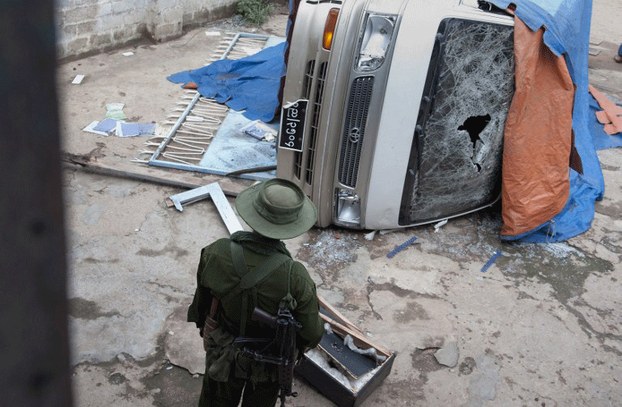
A soldier looks at a damaged vehicle after a spate of violence in Lashio in eastern Myanmar's Shan state, May 30, 2013. AFP
Mobs armed with swords and sticks torched dozens of shops and houses in Myanmar's central Sagaing region at the weekend in new communal violence sparked by reports that a Buddhist woman has been sexually assaulted by Muslim men, according to witnesses and officials.

Several people, including a regional security minister, a fireman and a monk who moved to contain the violence, were injured after being hit by slingshots carried by some of the hundreds of Buddhist rioters who went on a rampage in Htan Gone village in Sagaing's Kanbalu township, they said.

Some reports said up to 1,000 rioters were involved, attacking also a mosque and preventing fire enginers from reaching the razing homes and shops.

Police had to fire several rounds of warning shots to keep the mobs at bay and detained about a dozen suspected arsonists as they brought the situation under control by Sunday.

It was the first anti-Muslim violence reported in Sagaing as communal unrest continues to spread after two deadly Buddhist-Muslim clashes erupted in western Rakhine state last year, threatening the reform drive by reformist President Thein Sein.

Police station mobbed

Kanbalu police said more than 30 Muslim houses and shops were gutted in the violence after, according to reports, a crowd mobbed a police station in Htan Gone village, demanding that a suspect detained over a reported assault of a Buddhist woman be handed over.

The woman was from a nearby village where the initiators of the riot came from, sources said.

"The district police chief arrived and requested the mob to break up," an eyewitness, Win Aung from a neighboring village, told RFA's Myanmar Service.

"As they went away in two groups, they destroyed some stalls near the police station and then one group went to the mosque pelting it with rocks," he said, adding that he witnessed about 60 people with swords and machetes going on a rampage.

"The Muslims inside [the mosque] retaliated. The rock-throwing went on for a few minutes," he said.

The mob then set fire to two Muslim owned teashops, and prevented firemen from going to the area to fight the blaze.

"When the fire-engine tried to force its way slowly, somebody hit a fireman with a slingshot, injuring his forehead," Win Aung said. The rioters also cut off two of the hoses used by the firemen.

He said a group of monks had pleaded with the angry mob to allow the people to prevent the blaze from spreading to the homes.

"Muslims were guarding the [two] well-built mosques [in the village] and they were not destroyed but all the shops and houses near a railroad owned by Muslims were destroyed," a woman villager told RFA.

Authorities blamed

A monk who tried to mediate was injured in the head by a slingshot while Kyi Myaing, the Sagaing division's security minister, and an army personnel were also hit, officials said.

Myint Naing, an opposition parliamentarian and medical doctor from Kanbalu, blamed the authorities for the violence, citing a lack of security measures to swiftly contain the situation.

"It shouldn’t have happened," said the lawmaker from opposition leader Aung San Suu Kyi's National League for Democracy. "My clinic had been there for 10 years and people have lived peacefully without a fight. Violence had erupted in [other places as well in recent months] and why can’t they stop it?"

Two outbreaks of conflict in the western state of Rakhine in June and October last year left about 200 people dead and 140,000 displaced, mostly Rohingya Muslims who are seen by many in Myanmar as illegal immigrants from Bangladesh.

The violence then spread to central Myanmar's Meikhtila and Oakkan towns in March and April respectively  and Lashio township in eastern Shan state in May.

A U.N. human rights envoy on a trip to Myanmar said that he had to abandon a visit to a refugee camp in Meikhtila last week after his car was attacked by a Buddhist mob.

Tomas Ojea Quintana, the special rapporteur on the situation of human rights in Myanmar, said that his Aug. 19 experience reminded him of the fear that had gripped residents during the violence then.

The Myanmar government has denied his claim, saying Quintana had faced "peaceful" protesters scrambling to hand him a petition and said it did not consider the incident an attack.

Reported by RFA's Myanmar Service. Translated by Khin Maung Nyane. Written in English by Parameswaran Ponnudurai.

Burma violence: Rioters burn Muslim homes and shops

Thousands of Muslims were left homeless after the clashes in Meiktila
BBC News

Rioters have burnt Muslim-owned houses and shops in an outbreak of apparent sectarian violence in Burma (also known as Myanmar).

The trouble broke out overnight around the central town of Kanbalu, when police refused to hand over a Muslim man accused of raping a Buddhist woman.

It is the latest in a series of attacks on the Muslim community that police have failed to control.

The state government has sent reinforcements to the area.

The violence is a stark reminder of how much anti-Muslim sentiment there is in Myanmar and how little the authorities are doing to contain it, says the BBC's Jonathan Head in Bangkok.

Earlier this week, a car carrying UN human rights rapporteur Tomas Ojea Quintana was attacked by a crowd in the central town of Meiktila as he tried to investigate sectarian attacks there in March.

He has accused the country's government of failing to protect him when his convoy came under attack as some 200 people surrounded his car, punching the doors and windows.

At least 43 people - most of them from Burma's small Muslim community - died in the violence that erupted after an argument at a Muslim-owned shop.

The violence sparked clashes in at least three other towns and left more than 12,000 Muslims displaced.

The clashes in Meiktila were the worst since ethnic violence in Rakhine state last year, where nearly 200 people were killed and tens of thousands forced from their homes.

The conflict that erupted in Rakhine involved Buddhists and Rohingya Muslims, who are not recognised as Burmese citizens.

The communities remain largely segregated in the wake of the violence, with many displaced Rohingya Muslims living in tents or temporary camps.

UN Envoy Evaluates Burma Rights Following Ethnic, Religious Violence

U.N. envoy Tomás Ojea Quintana speaks to VOA in Bangkok, Aug. 23, 2013.
VOA News , August 24, 2013

BANGKOK — Tomás Ojea Quintana, the U.N. special rapporteur for human rights visited Burma last week on a 10-day mission to areas hit by waves of ethnic and sectarian violence over the past year. In Meikhtila, where thousands of mostly Muslim people were displaced by fighting in March, Quintana said his vehicle was overrun by a mob of some 200 people who kicked and shouted abuse. The comments drew international attention, and a rejection from the Burmese government which insisted he was well protected and the group only wanted to give him a letter and a T-shirt.

Quintana also visited the previously inaccessible Chin state and Burmese political prisoners. He spoke with VOA in Bangkok late Friday.

What is your overall assessment of Burma's human rights situation and how the international community should respond to the events of the past year?

“Myanmar has moved forward in many different areas, and this has brought an improvement of the human rights situation in general. It has also the potential to improve more for human rights in the future so there is a challenge for the government to really continue in this right direction. The international community has also responsibility to support the government in this regard. But also, and most importantly according to my views, is to keep on the agenda of the reform process the human rights. That's my message to the international community.”

“Myanmar has changed dramatically as I say the situation has improved, also dramatically in many many different areas but there are still serious shortcomings and that's why the general assembly the country member states of the United Nations had the responsibility to help Myanmar in keeping the human rights as one of the priorities in the process of reform.”

You were in the very remote and isolated Chin state for the first time. What was your impression?

“This was my first time in five years in the mandate to visit Chin state. I need first to express my appreciation to the government for arranging this visit. Logistically speaking it was very difficult, and the government put all their efforts in this regard. Chin state, it's a very important state in Myanmar framework. It's a state which is totally underdeveloped this is my first judgment in respect to Chin state. It's a lack of electricity, it's a lack of drinking water. There's no roads. And Chin state has somehow been abandoned by the previous government, the military government throughout the years, and it's the time for this new government who is going through this transition to really also pay attention of the people living in Chin state. Another issue in Chin state is a question of freedom of religion. You may know that most of the people living in Chin state are Christians, and [there] have been some allegations that for example students going to Na Ta La schools, these are schools on the border areas, have been converted from Christian to Buddhism and there are concerns in this respect. And from my point of view being on mission in Chin state I couldn't find specific evidence in this respect but we need to pay attention on how the freedom of religions of the people of the community living in Chin state are respected. Because in the past there have been serious incidents where crosses were destroyed and these kind of incidents. This happened in the past. Now the situation has improved in this respect but we need to pay attention on that.”

You raised concerns about the possibility for the communities of Rakhine state to reconcile after the violence. Please elaborate.

“After this mission just some days ago, I found that this policy of separating communities and segregation which was meant to be transitory at the beginning just to avoid more violence, it seems that this policy is becoming permanent. And the problem there is that this is affecting mostly the Muslim community. Because in the IDP camps where the Muslim community are, or in the villages in Sittwe, which are all blocked with armed guards around, they are not being allowed to move from there. There is a problem with the freedom of movement with these communities, with the Muslim communities they could not make up their livelihood and this is bringing a lot of concerns from the humanitarian point of view. So I think that the challenge is how to move forward from this policy of separating communities which is quite difficult, because as you just said, there is a lack of trust among communities, clear lack of trust, which was evident during the violent incidents last year. The government of Myanmar has a challenge on how to overcome that, on how to get these communities together to start finding solutions.”

Presidential spokesperson Ye Htut claimed you were mistaken to believe the police failed to protect you from the crowd you encountered in Meikhtila, and you mistakenly understood them to be a violent mob. Would you like to amend your account of the events?

“I would like to refer to my statement. My statement describes the facts of what happened the description of what happened is quite clear. Let me just maybe make two or three points. First I never said it was an attack just described the facts and I never also said that these 200 mob who descended on my car were Buddhists I cannot say that and I want to make a clarification on that and I want to say that it was not only me in that incident violent incident it was also the resident coordinator of the United Nations in Myanmar who also faced that same violent approach and also three people working for the United Nations.”

What was it that you saw that lead you to believe the police were unable to protect you? Were they standing by without acting?

“That's correct, you said it, I saw the police nearby just stood by, without really interfering what this mob was actually doing, which was very violent reaction against this rapporteur. And immediately came to my mind, that the people who suffered the violence in Meikhtila were under the same situation, where the police was not intervening. They were subject for hours to people totally exacerbated with the violence, for hours, so that's why I thought that the best way to make everybody know about what happened is to just let them know what I felt at that moment was the same inside of this Muslim community from Meikhtila might have suffered which caused the death of more than 43 people who were killed by kicks, stabbed and fire. So this is the main point.”

Do you believe the ongoing peace process in Kachin state is credible?

“Absolutely. There is a genuine willingness from President Thein Sein and those working with him towards stopping the fighting in Myanmar and this has to be supported from this special rapporteur.  Many cease-fire agreements have been reached, there are some others that are still under negotiations we need to support this because Myanmar has suffered for decades the consequences of the internal armed conflict between the government the armed forces from Myanmar the Tatmadaw, and armed groups. This is the time we should start solving this problem now. What I can say is this: that in parallel to this process that the president is leading, what is needed is that the ordinary people the communities at the grass root level are included in this process so they can feel they can trust that this process is genuine and they can feel that this process can bring a change for their future. I travel around Myanmar and it's difficult to see that these communities are really seeing this cease-fire process, which I commend, but the communities are seeing this process as a step forward with respect to their livelihoods.”

You visited Mae Sot, and spoke with people in the refugee camps. What is your estimation of how viable it is for them to return to their homes after the conflict?

“There is a lot of expectations, but also a lot of fears. When memories came from what happened to them from what made them flee the country so what is actually needed at this moment, together with the process of reaching cease-fire agreements from the government side, what is needed  is a clear plan on how the returning will be. Because there are issues of land mines, there are issues of people have lost their land, there is still a lot of fear, although many years has passed from the conflict, there is still a lot of fear from the refugees to return to Myanmar. So there is a challenge. Also for the government, they should start working on a very specific plan for the returning together with the U.N., the help of the U.N. and other international agencies.”
 
Myanmar News Now: Copyright © 2013. Thit Htoo Lwin News - All Rights Reserved
Myanmar online advertising by myOpenware